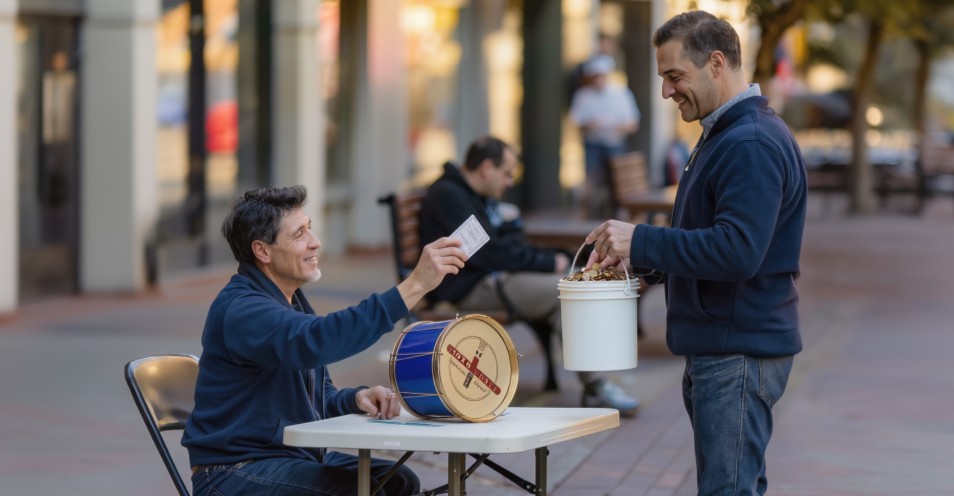
Most charities think about their supporters as one group, sorted by how much and how often they give. But there's a real, researched split hiding inside that group: habitual donors, people who give once or twice a year or on an ongoing basis, and a much larger population who simply don't respond to a direct ask at all. Fundraising research treats these as genuinely different response patterns, not two ends of the same spectrum.
That second group isn't a footnote. It's most people.
What actually moves them, when a donation ask doesn't
A chance-based incentive attached to the action does, and this isn't just a marketing hunch. The same underlying mechanism has real legislative weight behind it in a completely different context: "prize-linked savings" accounts, where a bank ties a small lottery to an ordinary savings deposit, have been legally recognised nationwide in the United States since the American Savings Promotion Act of 2014. Banks adopted this specifically because it reliably motivates people who standard interest-rate incentives never reach. Researchers studying these products found they activate saving behaviour in exactly the population that ignores conventional appeals to save more.
The parallel to giving isn't a stretch. Pair a small chance of winning something with the act of contributing, and you reach a genuinely different slice of the population than a straightforward donation ask does.
This shows up in how the money itself gets counted
Research into Australian giving behaviour has tracked raffle and lottery income as a distinct category sitting alongside, not inside, direct donations — worth billions of dollars a year in its own right. That's not an accounting quirk. It's evidence of a genuinely separate stream of support, sitting next to, not folded into, everything charities already count as "donations."
So is a "lottery buyer" actually a different kind of person, or just a different mood?
Genuinely different, for a meaningful share of people, not just a different mood on the day. A 2025 donor segmentation study identified a specific group researchers call "Charitable Sceptics" — donors who show a real, measurable difference between how they respond to a straightforward donation ask and how they respond to a raffle. It's not that this group dislikes charity. It's that a raffle offers something a plain donation ask doesn't: a tangible potential benefit back, not just a receipt and a thank-you email. Older experimental research backs this up structurally too — pairing a lottery with a donation ask has been shown to increase total giving compared to a plain ask, not just redirect the same money into a different format.
None of this means a donor and a ticket buyer are two separate species. A regular donor might also buy a ticket. A ticket buyer might also, separately, be a regular donor to a completely different cause. The overlap is real, and so is the gap. What the research actually supports is simpler than a conversion story: these are two genuinely different response patterns sitting in the same population, and a lot of charities have never had a reason to notice, because they've only ever run one kind of appeal.
Two different instincts, not one funnel
That's the actual, practical point. Not that one group should become the other, but that a donation ask and a lottery ticket are talking to two different instincts, and a charity that only knows how to make one of those asks is only ever speaking to half the room.
For a charity weighing up whether a lottery partnership is worth the effort alongside its existing fundraising, this is the real answer to "won't this just cannibalise our regular donors." The research suggests the opposite: it's a different door, for people who were never going to walk through the one you already have.
- Hart, D.J. & Gonul, M.S. — Multichannel Philanthropists Versus Cash Contributors: Segmenting Charitable Donors in the Digital Age (Journal of Nonprofit & Public Sector Marketing, 2025)
- Lange, A., List, J.A. & Price, M.K. — experimental research on lotteries increasing charitable contributions relative to plain donation asks (2007)
- American Savings Promotion Act of 2014 (U.S. Public Law 113-251)