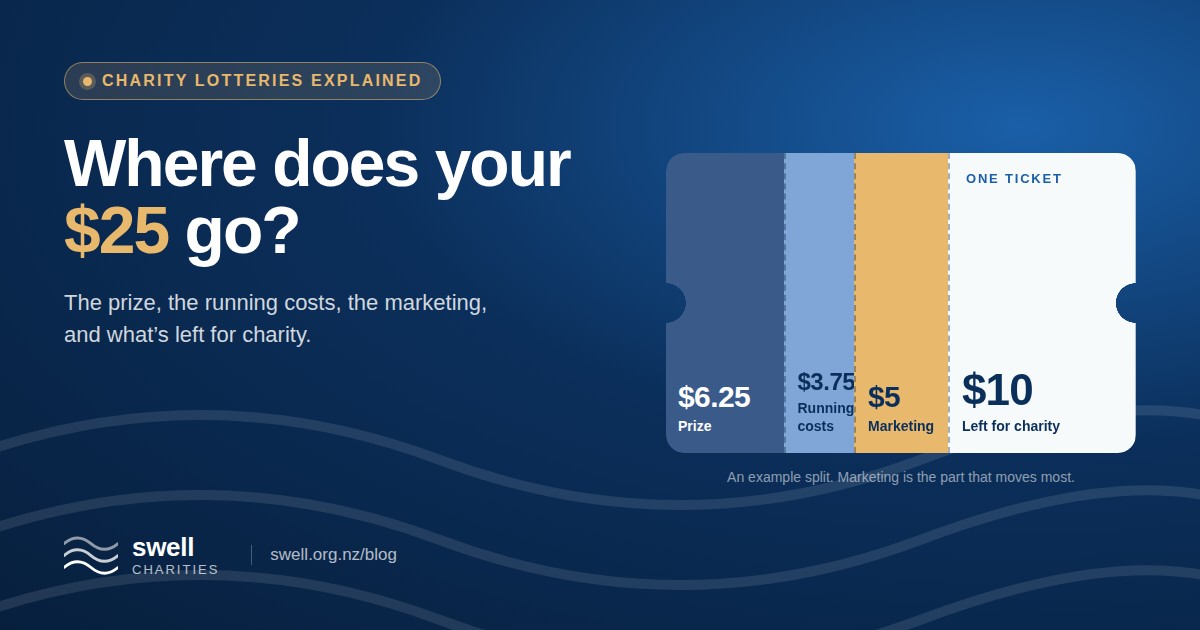
When you buy a $25 ticket in a charity lottery, the money goes to three places: the prize, the running costs and the charity. How it splits between them varies a lot more than most people expect.
The prize
The law sets a floor. Prizes must be worth at least 20% of the tickets on offer.
Most lotteries give more than that. In our directory, the share going to prizes runs from exactly 20% up to 48%.
Before a single ticket sells
Most people picture a charity lottery as a prize and a pile of tickets. The real list is much longer.
Getting legal
- The licence. $88.89 plus GST if prizes are worth $50,000 or less, and $628.44 plus GST above that.
- Terms and conditions. Written to meet the licence rules, and ideally checked by a lawyer.
- Privacy policy and data handling. You’ll be collecting thousands of names, emails and card payments.
The prize
- Buying it, or negotiating a sponsor deal.
- Deposits and payment timing, often before tickets go on sale.
- For a car: registration, on-road costs and delivery. For a house: legal fees and transfer.
- Insuring and storing it until the draw.
The website
- Design and build of the lottery site.
- Hosting, domain and security certificate.
- A ticketing system that issues unique, numbered tickets and emails them instantly.
- Testing on phones, tablets and every major browser.
- Testing the full payment flow, including failed and declined cards.
- Load testing, so the site doesn’t fall over on launch day or in the final-hours rush.
Taking payments
Every $25 ticket loses a little along the way, and it happens in layers.
- Payment gateway fee. The platform that takes the card, usually a percentage plus a fixed amount per transaction.
- Card scheme and bank fees. Visa, Mastercard and the banks each take a share, often bundled into the gateway rate.
- Higher rates for some cards. Amex, international and corporate cards usually cost more to accept.
- Refunds. The original fee often isn’t returned when you refund a ticket.
- Chargebacks. When a buyer disputes a payment, there’s usually a fee whether you win the dispute or not.
- Fraud screening to catch stolen cards before they cost you a chargeback.
- Payout fees for moving the money into your bank account.
Marketing creative
- Photography and video of the prize.
- Copywriting for ads, emails, the website and social posts.
- Ad designs in every size each platform needs: square, portrait, story and banner.
- Short video edits for Reels, TikTok and YouTube.
- Several versions of each ad, so you can test which sells tickets.
- Email designs for the launch, reminders and “last chance” messages.
- Print material if you’re selling locally: posters, flyers and counter cards.
Running it day to day
- Email and SMS platform costs.
- A customer support inbox, and ideally a phone line, for lost tickets, typos and “did my payment go through?”
- Daily reconciliation of sales against payments.
The draw and after
- An independent witness, such as a Justice of the Peace or Police.
- A venue or livestream for the draw.
- Publishing the results, which for many lotteries means a paid newspaper notice.
- Contacting and verifying the winner, and handing over the prize.
- The independent audit, and the final return to DIA.
None of these costs are huge on their own. Together they add up before the first ticket is sold, and some of them, like the prize deposit and the creative, have to be paid up front.
Then there’s marketing
This is the cost nobody can quote, and it decides whether the lottery makes money.
Tickets don’t sell themselves. Someone has to find 10,000 buyers. If the charity already has a big, engaged supporter list, a few emails might do it. If it doesn’t, it has to pay to reach people, and that gets expensive quickly.
Here’s why it matters. Take a lottery of 10,000 tickets at $25, with a quarter of the takings going to the prize and 15% to running costs.
It’s the same lottery with the same prize, and there’s a $50,000 difference in what’s left for the charity.
The first bar is also how we split a ticket in a Swell partnership. The $10 left for charity is shared between our partner charity and Swell, which is a charity too.
And then there’s your time
Money isn’t the only cost. A first lottery takes about eight weeks to prepare before a single ticket goes on sale, and there are about four weeks of preparation between one lottery and the next. Add the sales period, and each lottery usually runs four to five months from start to finish. Here’s who does what in that time.
| Task | On your own | With Swell |
|---|---|---|
| Licence application and terms | Your team | Swell |
| Sourcing and negotiating the prize | Your team | Swell, with your input |
| Briefing, building and testing the website | Your team and a developer | Swell |
| Setting up payments and fraud checks | Your team | Swell |
| Creative: photos, video, ads, emails | Your team and an agency | Swell, with your approval |
| Planning and buying ads, week by week | Your team | Swell |
| Daily social posting | Your team | Swell, plus your shares |
| Answering ticket-buyer questions | Your team | Swell |
| Refunds and payment problems | Your team | Swell |
| Daily sales reconciliation | Your team | Swell |
| Running the draw and publishing results | Your team | Swell, with you there |
| Winner handover | Your team | Together |
| Audit and DIA return | Your team and an accountant | Swell |
| Telling your story and sharing with supporters | Your team | Your team |
Run it yourself, and that’s four to five months of part-time work for someone, usually someone who already has a full-time job at your charity. With Swell, your time goes into the one thing nobody else can do: telling your supporters why it matters.
The line that gets left out of the budget
Charities planning a first lottery tend to budget carefully for the prize and the licence, because those have a price tag. Marketing often goes in as a hopeful guess, or doesn’t go in at all.
There’s a second problem. Marketing has to be paid for before the ticket money arrives. A charity needs cash set aside to promote the lottery in its first weeks, at the point when it has already paid for the prize.
When that money isn’t there, the lottery launches quietly, sales are slow, and the draw date arrives with tickets unsold. The prize still has to be paid for in full.
Why online marketing matters
Since November 2024, licensed lotteries have been able to sell tickets online permanently. That changed what marketing can do. Online, it can be tracked and adjusted while the lottery is running, rather than locked in at the start and hoped for.
Done well, it’s often the difference between a lottery that sells out and one that doesn’t.
What’s left for the charity
Whatever remains after the prize and the costs. There’s no legal minimum, so it depends on how well the lottery sold and how much it cost to sell.
How Swell does it
Run a lottery on your own, and your charity takes on the risk. It costs your team a lot of time, and it can cost you money too.
Run it with Swell, as a lottery partnership between two charities, and it doesn’t.
If you’d like to talk it through, get in touch.